Manufacturing · ERP & Digital
Moving production quality checks from paper to real-time data
A tablet-based quality-recording workflow replaced end-of-day manual transcription with real-time data capture, reducing handoffs and helping production leaders respond sooner.
- USD 30,000
- reported annual workforce savings per line
- Real time
- quality data capture and review
01 · Context
The challenge
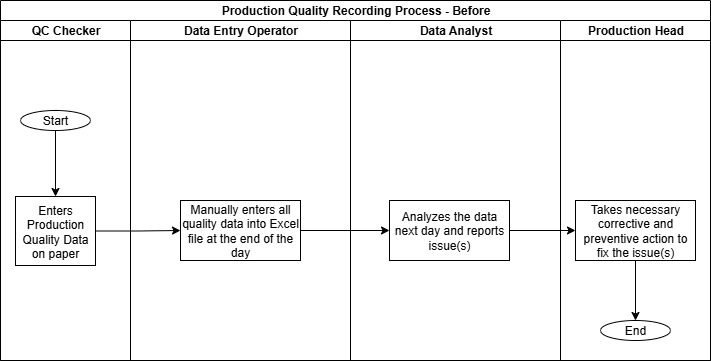
- Manual data entry by quality-control checkers was inefficient.
- Multiple handoffs delayed data processing and corrective action.
- Operators entered the day's data at the end of the day, delaying availability.
- Repeated data entry increased the likelihood of errors.
- Repeated transcription reduced confidence in data credibility.
- Slow processing could delay data analysis.
02 · Delivery
The approach
- 01Initiated a software-development project and developed its project charter and plan.
- 02Gathered master data, including employee ID, machine, product, operation, and production-line codes.
- 03Started development on the Oracle APEX platform.
- 04Provided the software team with dashboard, KPI, chart, trend, and calculation-formula requirements.
- 05Completed user-acceptance testing and bug fixing.
- 06Established user roles and permissions.
- 07Hosted the software on a local server.
- 08Installed the software on user tablets.
- 09Trained users.
- 10Continued support and maintenance.
Engagement evidence
Measures and working visuals
Source report detail
Project timeline and takeaways
Delivery timeline
- 3–4 monthsSoftware development, testing, deployment, user training, and ongoing supportPhase 1
Findings and recommendations in the report
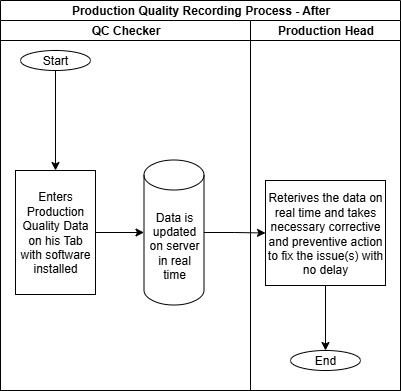
- Quality data could be entered in real time.
- Fewer handoffs supported more credible data.
- Data analysis was automated.
- Results were described as faster, lower-cost, and more reliable.
- Timelier corrective action could help prevent future issues.
- Quicker responses could reduce downtime.
- The report identifies improved compliance and fewer penalties as benefits.
- The report estimates USD 30,000 in annual workforce savings per production line.
- The report estimates USD 2,000 per year per line from error reduction.
- The source also lists USD 5,000 in savings from reducing one hour per day of delay per production unit, without specifying the benefit period.
Client and employee identities are withheld. Reported figures are retained as source claims; discrepancies are noted rather than silently corrected.
03 · Outcomes
What changed
- 01Quality observations could be entered digitally at the point of work and processed in real time.
- 02The redesigned workflow reduced handoffs and enabled production leaders to review issues sooner.
- 03The report estimates USD 30,000 in annual workforce savings per production line and USD 2,000 in annual error-reduction savings per line.
- 04The source also lists USD 5,000 in savings from reducing one-hour-per-day delays per production unit, but does not state the benefit period; no annualized figure is inferred.
Client identity is withheld. Outcomes and measures are presented as documented in the engagement source material.