Textile Manufacturing · Consulting
Preventing nickel deposition by stabilizing printing-paste pH
A PDCA investigation identified a pH-control gap in textile printing and changed the testing sequence so the paste could be checked after pigment addition.
- 0
- reported nickel-deposition events after improvement
- 0
- reported related customer complaints after improvement
01 · Context
The challenge
- Nickel on finished garments was reported at more than four times the allowed limit.
- A customer in Germany made a claim involving more than 50,000 garments.
- The customer was dissatisfied, creating a risk to the customer relationship.
- Recurring quality issues threatened customer retention.
- Non-compliance created a risk of contract termination.
02 · Delivery
The approach
- 01Applied the Deming PDCA process-improvement method.
- 02Formed a cross-functional team.
- 03Collected and analyzed production data.
- 04Consulted the nickel-based printing-screen manufacturer, identified in the report as Stork (SGS Prints).
- 05Involved textile-chemistry and materials-science subject-matter experts.
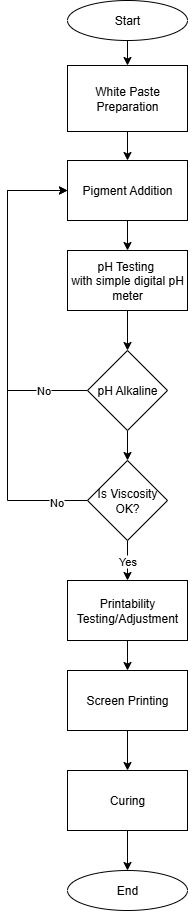
- 06Monitored pH with a digital meter designed for creams, toothpaste, and cosmetics.
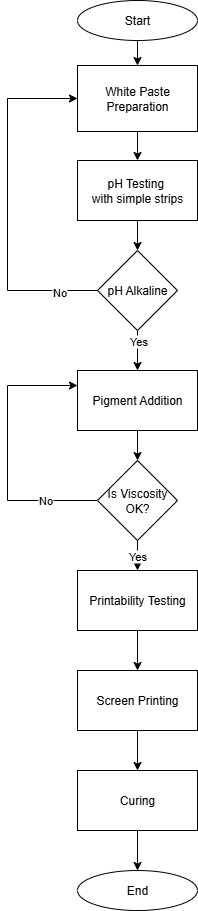
- 07Identified that printing paste could become acidic after pigment was added.
- 08Changed the process sequence so pH is measured after pigment addition to verify the paste remains alkaline.
Engagement evidence
Measures and working visuals
Source report detail
Project timeline and takeaways
Delivery timeline
- 1 weekProblem definition and team formationPhase 1
- 1 weekTeam training in root-cause analysis and data analysisPhase 2
- 1 weekConsultation with the screen manufacturer and subject-matter expertsPhase 3
- 1 weekDesign and implementation of the revised process sequence and digital pH-meter testingPhase 4
Findings and recommendations in the report
- The report records zero observed nickel-deposition events on printed fabric after improvement.
- The process was changed to prevent pH fluctuation from contributing to nickel removal from the printing screen.
- Monitoring and adjustment were improved.
- The report describes real-time transfer of pH-meter readings to computer software.
- Customer complaints about heavy metals (nickel) on garments were reported to have fallen to zero.
Client and employee identities are withheld. Reported figures are retained as source claims; discrepancies are noted rather than silently corrected.
03 · Outcomes
What changed
- 01The report records zero observed nickel-deposition events on printed fabric after the process change.
- 02The report states that customer complaints relating to nickel presence fell to zero.
- 03A revised process flow introduced a post-pigment pH check before printing proceeds.
Client identity is withheld. Outcomes and measures are presented as documented in the engagement source material.